





Workbooks AI Agents
Use Agents to prompt Workbooks AI with pre-defined instructions, for example to define responses such as a Statement of Work, Meeting Minutes, or an Account Summary. Agents help standardize how the AI responds, ensuring outputs are consistent and aligned with your business requirements.
Agents
Agents allow you to pre-write instructions for Workbooks AI that can be reused across your organization. Each Agent contains a prompt that guides the AI on what to generate and how to structure its response.
For example, you could create an Agent on Opportunities called “Create SOW”, which includes a predefined list of job functions or sections that the AI should include when generating a Statement of Work.
Common use cases for Agents include:
- Generating Statements of Work
- Producing structured meeting minutes
- Creating account or opportunity summaries
- Standardizing internal documentation
Tip: A ready-made “Create SOW” Agent is available from the Library via Start > Configuration > Workbooks AI > Agents > Library.
Note: When using an Agent to update a record, a banner will appear saying ‘This record has been modified since you opened it. Reload to access the latest version.’ Make sure you save any changes you have made to the record before asking AI to update the record as you may lose these.
Agent Visibility
Agents can be limited to specific record types, ensuring they only appear where relevant. You can further restrict their availability by assigning categories that correspond to specific form layouts.
When categories are specified, the Agent will only appear on matching form layouts. If categories are left blank, the Agent will appear on all layouts for the selected record types.
It is possible to control which Users or User Groups the AI Agents are shared with, so that they do not appear for everyone. This helps reduce the number of Agents users see that are irrelevant to them and allows Agents to be restricted where they perform functions that only certain users should have access to. For more information on Sharing Policies, click here.
Agent Configuration
When run, some Agents are able to present clickable, button-based choices to users during a conversation. This allows the AI to offer structured options rather than relying on free-text input, enabling workflows like action plan approvals where users can approve or reject suggestions directly via buttons.
Additionally, within the Agent configuration, you can control how Workbooks AI generates responses.
Configuration options include:
- Output Token Limit: Sets the maximum length of the AI’s response. The default value is 7,500 tokens, helping you control how concise or detailed outputs should be.
- Creativity: Controls how predictable or inventive responses are, ranging from Most Predictable (0.0) to Maximum Creativity (1.0). Lower values produce more consistent and focused responses, while higher values encourage more varied output. The default value is 0.2.
These settings allow you to fine-tune Agents so the AI produces outputs that match your organization’s tone, level of detail, and consistency requirements.
Grouping AI Agents
You can organise your AI agents into groups, making it easier to manage them. As you create more AI agents for a record type, they can start to crowd the bottom of the chat window, making it harder to quickly find and use the right agent.
With Agent Groups, you can organise agents into structured sub-menus, helping you stay organised and navigate your agents more efficiently.
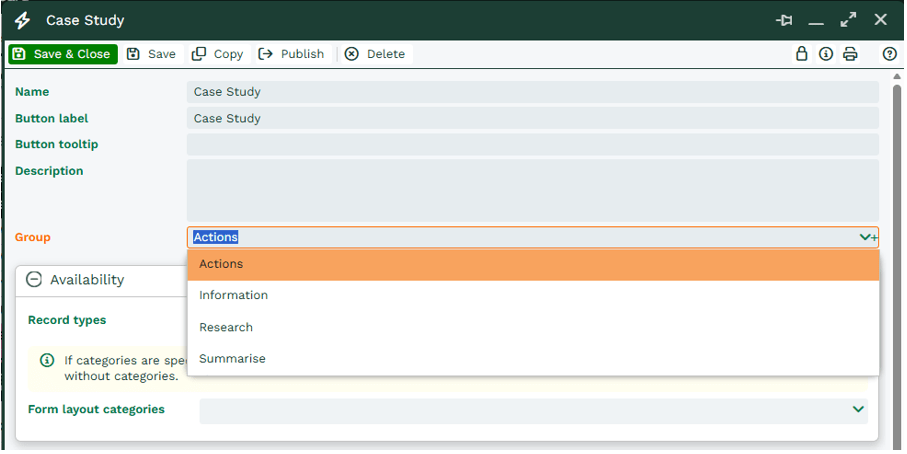
To assign an AI agent to a group, open an existing agent, for example, Case Study. You will see a field labelled “Group”, where you can select a group from a dropdown. The options in this dropdown are set within the AI Agent Groups picklist (Start → Configuration → Customisation → Picklist → AI Agent Group), which allows you to manage existing groups or add new ones as needed.
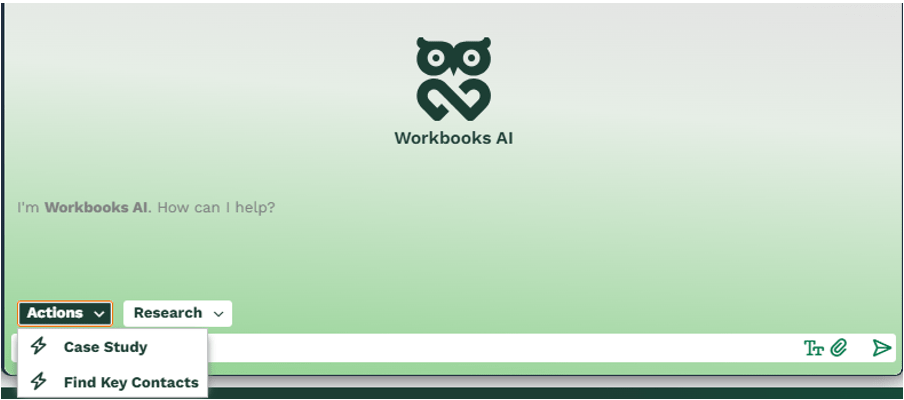
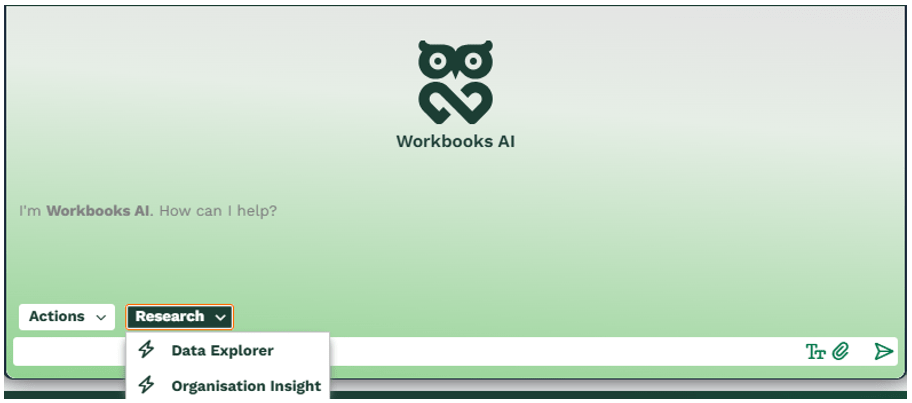
Agents can be organised into groups such as Actions, Summarise, Information, and Research. For example, you might place Case Study and Find Key Contacts under the Actions group. The first screenshot below shows how these agents appear when they are part of the Actions group. Agents such as Organization Insight and Data Explorer can be placed under the Research group. The second screenshot demonstrates how these agents are organised within the Research group, making it easier to navigate and select the right agent.
Workbooks AI Tools
Revision History
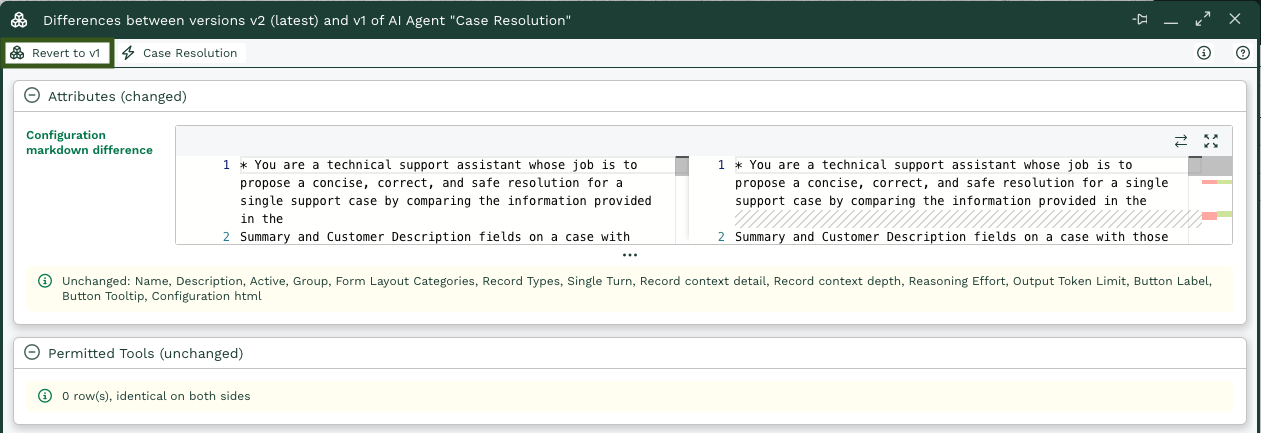
The Revision History tab within Workbooks AI Tools provides a clear audit trail of changes made to a Tool over time. It enables administrators to view previous versions, including what was modified, when the change occurred, and who made the update. This allows you to track the evolution of a Tool, troubleshoot issues by comparing versions, and, where necessary, revert to an earlier configuration.
Within the tab we are able to compare different versions of the scripts:
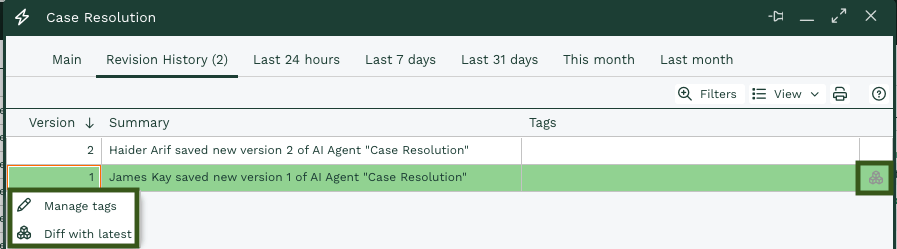
By clicking on the version number we are presented with the options on the left or we can click on the audit icon on the right hand side to open the changes between the versions side by side